It's Thursday, 7:30 pm. Your best slot of the week. The court is lit, the room is warm, the therapist is ready. And nobody walks in.
No call. No message. Just an empty hour you can't sell again.
If you run anything that works on appointments, you know this feeling. And you probably know the usual advice too: "send reminders." That helps, but on its own it rarely fixes the problem. To actually reduce no-shows you need a few small systems working together: the right reminders, a clear cancellation policy, some money on the table, and a quick way to refill the gap when someone drops out anyway.
This guide walks through all of it, with real numbers, a policy you can copy, and a checklist you can finish this week.
What a no-show really costs you
Most owners underestimate it because a no-show doesn't show up as a loss on any report. It shows up as revenue that never happened. So let's put a number on it.
Take a padel venue with three courts at 200 SAR an hour. If two bookings a night don't turn up:
Price per court hour: 200 SAR
No-shows per night (whole venue): 2
Lost per night: 400 SAR
Lost per year (365 nights): about 146,000 SAR
Now a small spa: one missed 250 SAR treatment a day, 26 working days a month. That's 6,500 SAR a month, or 78,000 SAR a year. And that's before you count the therapist's paid time, the towels you prepared, and the customer you turned away because the slot looked full.
Run the math with your own prices. Take your average booking value, multiply by the no-shows you had last week, and multiply by 52. Most owners stop arguing about deposits after they see that figure.
Why customers don't show up
Very few people skip on purpose. In our experience talking to venue owners, the reasons fall into a handful of buckets:
They forgot. The booking was made two weeks ago in a hurry, between other things.
Plans changed and cancelling felt like a hassle. If cancelling means a phone call during working hours, many people just don't bother.
Nothing was at stake. A free booking costs nothing to abandon.
They're running late and assume it's too late. So they don't come at all.
They booked "just in case." Common with group sports, where one person books and the group never confirms.
Each fix below targets one or more of these. That's why a single tactic is never enough.
What the research says about appointment reminders
Reminders are the most studied fix, mostly in healthcare, where no-shows are measured carefully. Some of the strongest evidence comes from Saudi Arabia itself.
In a randomised trial at an internal medicine clinic in the Eastern Province, patients who received an SMS reminder missed 26.3% of appointments. Patients who didn't missed 39.8%.
Youssef, Eastern Mediterranean Health Journal, 2014
Here is how the three best-known studies compare:
Youssef, Eastern Mediterranean Health Journal, 2014. Internal medicine clinic, Eastern Province, Saudi Arabia. No-shows: 39.8% without a reminder, 26.3% with an SMS reminder.
Altuwaijri et al., Saudi Medical Journal, 2012. 16 clinics at King Abdulaziz Medical City, Riyadh. No-shows fell from 23.9% to 19.8% after SMS reminders started.
Jegathesan et al., BMJ Open Quality, 2022. Outpatient clinic in Toronto, one SMS sent 48 hours before. No-shows fell from 38.6% to 25.5%.
Two things stand out. First, reminders work everywhere they've been tested. Second, they don't get you to zero. Even with reminders, a quarter of patients in two of these studies still didn't come. That gap is where policy, payment and waitlists earn their keep.
9 fixes that reduce no-shows
1. Send appointment reminders, and time them properly
A reminder only works if it lands when the customer can still act on it. Two messages cover most cases:
24 hours before, so they can cancel or move the booking inside your free window.
2 to 3 hours before, so the booking is fresh in their head when they plan their evening.
Keep the message short. Name the venue, the service, the time and the branch, and give one link to manage the booking. SMS still beats email here because it gets read within minutes, and it's cheap: on VoM Flow, a 100-message pack is 50 SAR, which works out to half a riyal a reminder. One saved booking pays for hundreds of messages.
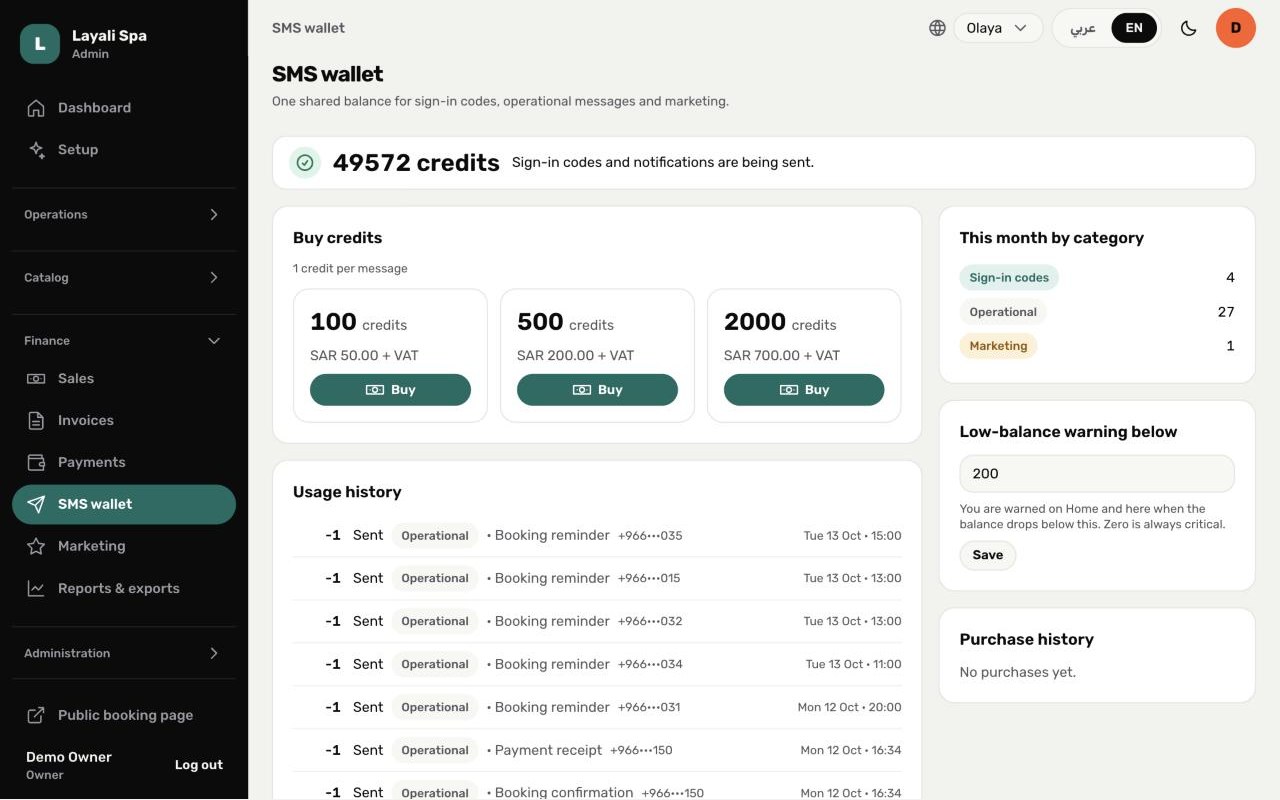
VoM Flow's SMS log: every booking reminder is listed with its status, and message packs start at 100 messages for 50 SAR.
2. Write a cancellation policy people actually read
A good cancellation policy answers three questions in plain words: until when can I cancel for free, what happens if I cancel late, and what happens if I don't come. That's it. If it needs a lawyer to read it, customers will ignore it and your staff won't enforce it.
A typical setup for a spa or salon looks like this:
Free cancellation up to 24 hours before the appointment.
A late cancellation fee inside that window (for example 50 SAR).
A no-show fee if the customer doesn't come (for example 75 SAR).
Free rescheduling up to 12 hours before.
Show the policy at the moment of booking, not hidden on a separate page, and repeat it in the confirmation message.
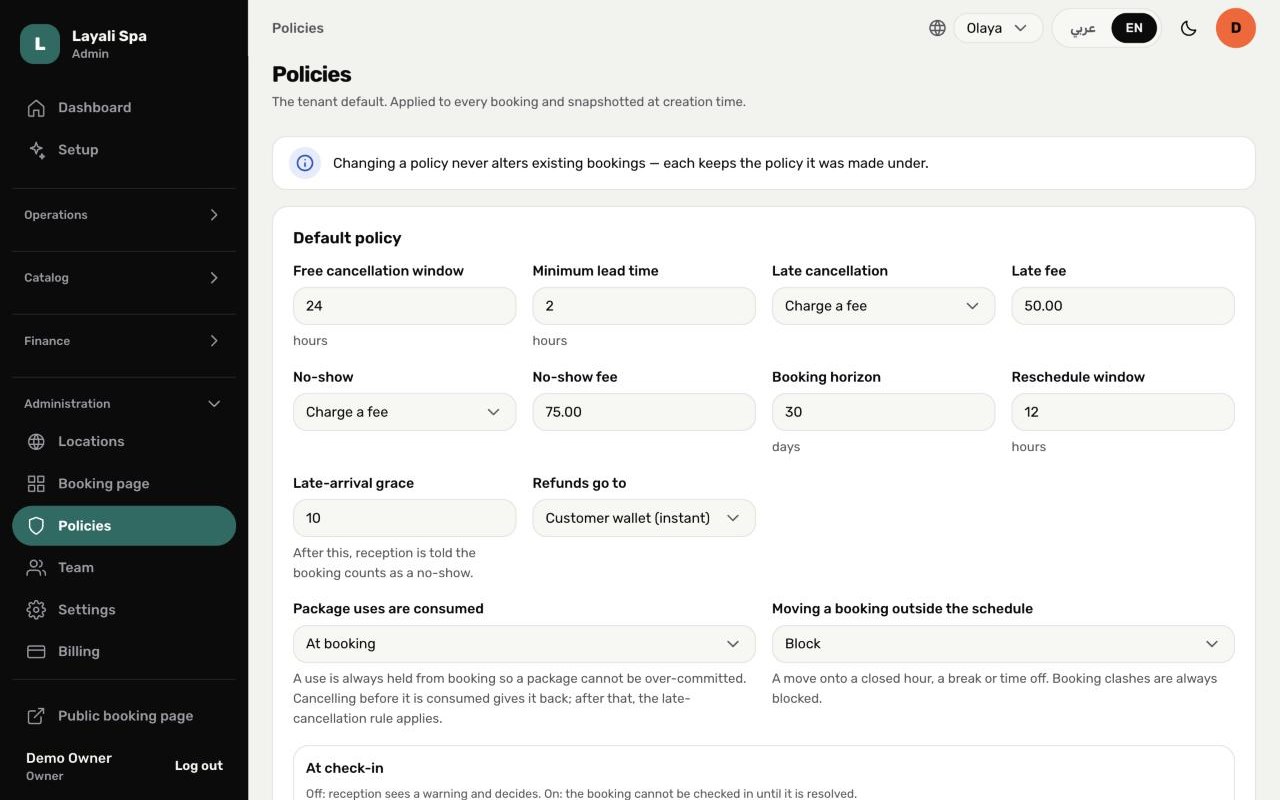
The Policies page in VoM Flow: free cancellation window, late cancellation fee, no-show fee, reschedule window and late-arrival grace period, all in one place.
One detail that matters more than it looks: when you change your policy, it shouldn't touch bookings that already exist. Customers agreed to the rules shown when they booked. VoM Flow locks each booking to the policy in force at the time it was made, so you can tighten the rules without a single awkward conversation.
3. Take prepayment or a deposit for the slots that hurt most
Nothing changes behaviour like money already paid. Prepayment is the strongest single fix for no-shows, and in Saudi Arabia it has become easy for customers: mada, Apple Pay and STC Pay make paying for a booking take seconds.
You don't have to charge upfront for everything. Start where no-shows cost the most:
Peak hours (evenings and weekends).
Long or expensive services.
New customers with no history at your venue.
Group bookings, where one person books for several.
If full prepayment feels too much for your market, a deposit of 20 to 30 percent still does most of the work. The customer has something to lose, and you have something to cover the empty slot.
4. Charge a no-show fee, and apply it every time
A no-show fee nobody enforces is worse than no fee at all. It teaches customers that your rules are decoration. The fix is to take the decision away from the front desk: if the policy says 75 SAR, the system applies 75 SAR when the booking is marked as a no-show. No negotiating at the counter, no favourites. If a manager decides to waive a fee for a loyal customer, VoM Flow lets them, and records who did it and why.
Rules that depend on a receptionist's mood don't get followed. Rules the system applies quietly do.
5. Make cancelling and rescheduling easy
This sounds backwards, but it works. When cancelling takes ten seconds from a link in the reminder, people cancel instead of disappearing. A cancellation 24 hours ahead is a slot you can sell again. A no-show is a slot you can't.
Give every booking a manage link, let customers move to another time within your reschedule window, and send refunds for eligible cancellations to a customer wallet so the money stays with you as credit for the next visit.
6. Set a grace period for late arrivals
Without a clear rule, your team improvises: some wait 30 minutes, some give the slot away after 5. Pick a number, usually 10 to 15 minutes, and make it visible.
In VoM Flow the late-arrival grace period is a setting. Once it passes, the check-in screen tells reception plainly that the booking now counts as a no-show, shows any amount still outstanding, and gives one button to mark it. There's also a WhatsApp button next to each booking for a quick "are you on your way?" before you make the call.
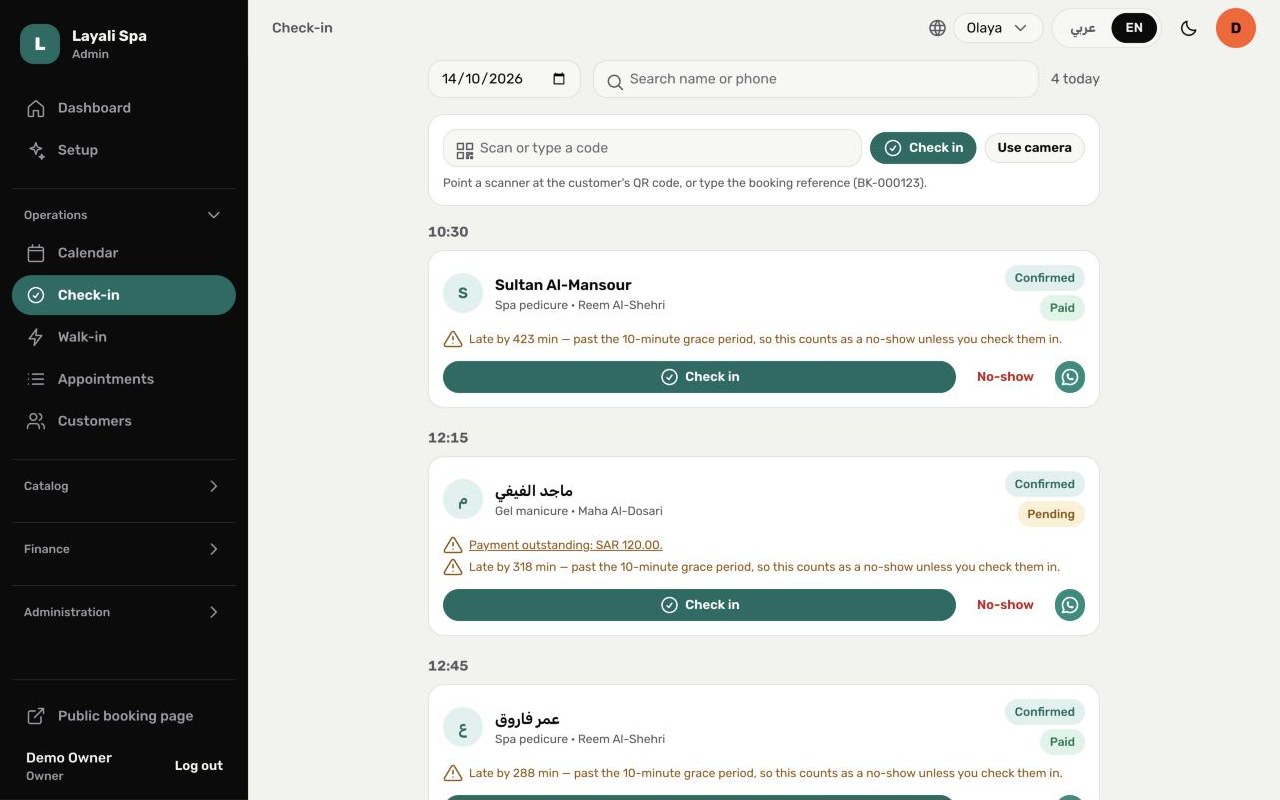
The check-in screen: late bookings are flagged once they pass the 10-minute grace period, with No-show and WhatsApp buttons on each card.
7. Keep a waitlist to refill the gaps
Even with everything above, some people will cancel late. A waitlist turns those cancellations into revenue. When a slot opens, the first person on the list gets a message and can take it in a tap.
In VoM Flow, when someone cancels a class, the freed seat goes to the waitlist automatically, so the front desk doesn't have to chase anyone.
Waitlists work best for things that sell out: evening courts, popular classes, a busy stylist on a Thursday. Keep the offer window short (an hour or two) so the slot doesn't sit empty while you wait for a reply.
8. Use WhatsApp for the last-minute nudge
In Saudi Arabia, WhatsApp is where people actually reply. SMS is perfect for automated reminders, but for the human touch ("we're holding your court, see you in 15?") a WhatsApp message from the venue gets a faster answer than a phone call.
Keep these messages short and friendly. They're a courtesy, not a warning.
9. Measure your no-show rate every month
You can't improve what you don't track. Look at two numbers each month:
No-show + late cancellation rate: the share of bookings that didn't turn into a paid visit.
Digital capture rate: the share of revenue collected online before the visit. The higher it is, the lower your no-show risk.
Check the trend after every change you make. If you introduced deposits in March, March should look different from February.
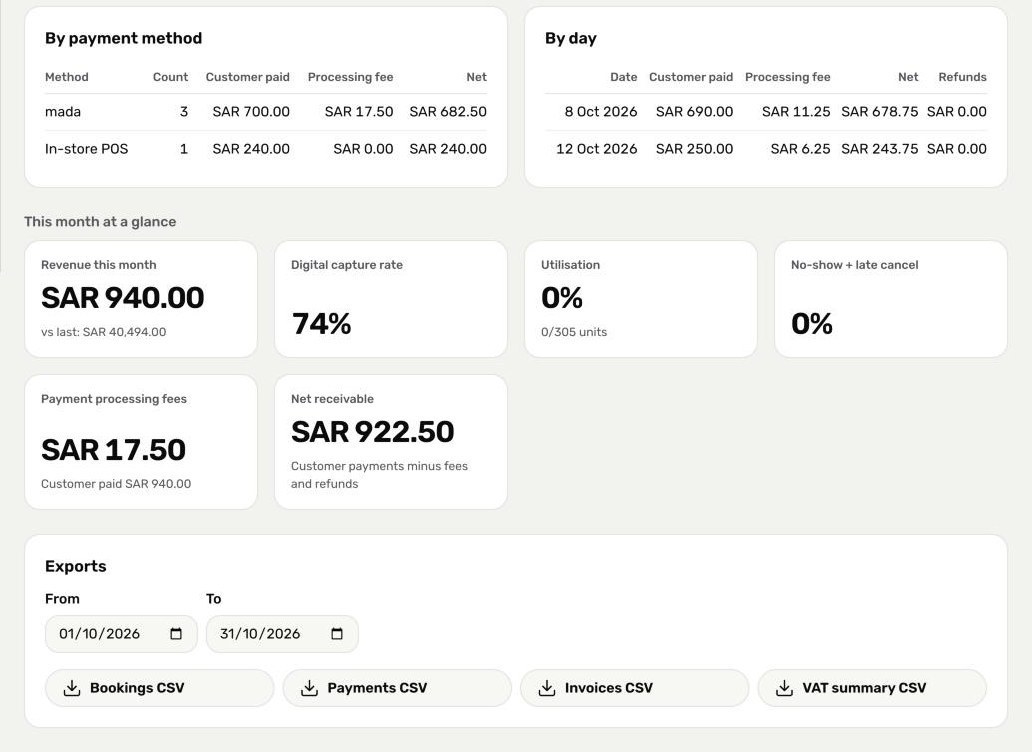
VoM Flow's reports show the no-show and late cancellation rate next to the digital capture rate, revenue by payment method, and CSV exports.
A no-show policy you can copy
Adjust the numbers to your prices, then put it on your booking page and in your confirmation message:
Booking and cancellation policy
You can cancel or move your booking for free up to 24 hours before your appointment.
Cancellations made less than 24 hours before are charged a 50 SAR late cancellation fee.
If you don't arrive and haven't cancelled, a 75 SAR no-show fee applies.
We hold your booking for 10 minutes after the start time. After that it's treated as a no-show.
Refunds for eligible cancellations go to your wallet and can be used on your next booking.
Your no-show checklist
☐ Reminders go out automatically 24 hours and 2 to 3 hours before each booking.
☐ The cancellation policy is shown at booking and in the confirmation.
☐ Peak slots and new customers pay upfront or leave a deposit.
☐ The no-show fee is applied by the system, not by the front desk.
☐ Every booking has a link to cancel or reschedule.
☐ The late-arrival grace period is set and the team knows it.
☐ Popular slots have a waitlist.
☐ Someone checks the no-show rate on the first of each month.
How VoM Flow helps
VoM Flow is a booking system built for venues in Saudi Arabia: salons, spas, clinics, padel and sports courts. Everything in this guide is built in. Reminders go out by SMS on their own, your cancellation and no-show rules live in one Policies page, customers pay online when they book (mada, cards, Apple Pay or STC Pay), and the check-in screen tells your team exactly what to do when someone is late. Every paid booking also gets a ZATCA-compliant e-invoice automatically.
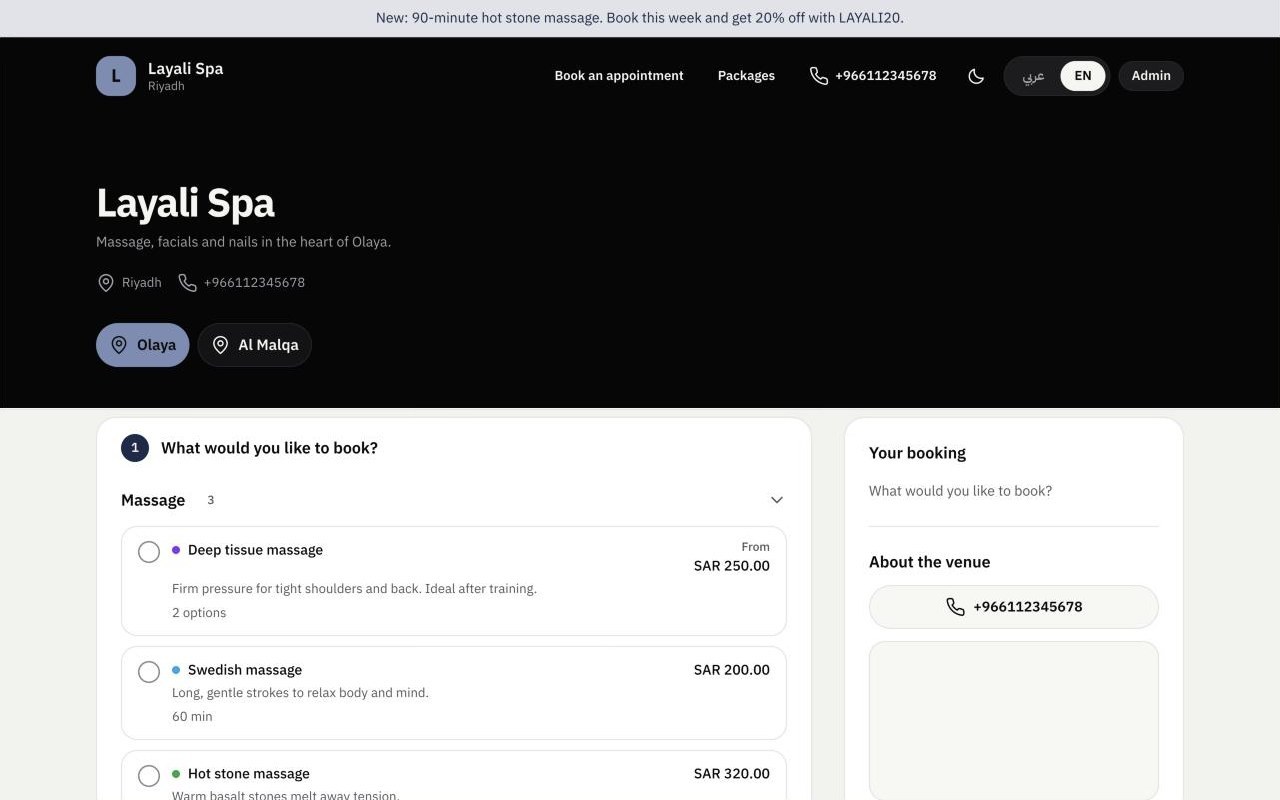
The customer's booking page: services, prices and online payment, in Arabic and English.
If no-shows are eating into your best hours, take a look at VoM Flow. Setting up your first policy takes a few minutes.
Frequently asked questions
What is a normal no-show rate?
It depends on the industry and how bookings are made, but the studies above show rates between roughly 20% and 40% in clinics without reminders. Venues that take prepayment usually see far lower numbers. The useful benchmark is your own rate last month.
Will a no-show fee scare customers away?
Not if it's clear and fair. Customers who plan to come don't mind a policy, and many appreciate knowing the venue takes their booking seriously. Offering free cancellation up to 24 hours ahead keeps it friendly.
When is the best time to send appointment reminders?
One message 24 hours before, so there's time to cancel and refill the slot, and a second one 2 to 3 hours before. For bookings made the same day, one reminder an hour or two ahead is enough.
Should I ask for full prepayment or a deposit?
Full prepayment gives the biggest drop in no-shows. A deposit is a good middle ground for markets or customers who aren't used to paying upfront yet. Many venues require prepayment only for peak hours and new customers.
Sources
Youssef A. Use of short message service reminders to improve attendance at an internal medicine outpatient clinic in Saudi Arabia: a randomized controlled trial. Eastern Mediterranean Health Journal, 2014; 20(5). emro.who.int
Altuwaijri MM, et al. SMS reminders and outpatient non-attendance at King Abdulaziz Medical City, Riyadh. Saudi Medical Journal, 2012; 33(2): 193-198. smj.org.sa
Jegathesan T, et al. SMS reminders and uninformed no-shows in an outpatient clinic: a quality improvement pilot. BMJ Open Quality, 2022. pmc.ncbi.nlm.nih.gov
Cost figures in "What a no-show really costs you" are worked examples, not survey data.